


Journey of Imagination

Kevin Caron sculpts whimsical forms that are born of curiosity and inspired by beauty.
By Rebecca L. Rhoades | Photography by Art Holeman
Looking back on his work, Kevin Caron laughs—and cringes—as he talks about one of the first sculptures he created. “It was an ocotillo made out of railroad spikes,” he says. “I thought it was cool and fun.” Recently, the artist ran across the piece while at a party in Carefree. “Here it is, 13 years later, and I thought, ‘My gosh, did I really make that? Can we push that a little farther into the weeds by any chance?’”
Self-deprecating humor aside, Caron is actually proud of all of his art—as well as the journey on which it has taken him.
As a truck driver prior to becoming a full-time sculptor, he would find himself mentally deconstructing the big rigs, starting with the steering wheel and making his way through the drive shaft and all the way down to the wheels. “It was a game. Let’s take it all apart and then put it back together,” he says. “I realize now that by doing that, I was teaching myself how to sculpt. I was learning how to take a finished image and break it down to the basic components and then figuring out what I need to do to re-create it.”
One day, he came across a discarded metal conveyor belt in the pallet yard where he worked, and he decided to take a chunk of it home and fashion a privacy screen for his backyard. The seed was planted, and soon Caron was creating pieces for friends, local galleries and even a few paying clients.
In December 2005, Mike Cohn, one of the Valley’s top art collectors, commissioned Caron to create another privacy screen, as well as a water feature, out of that same conveyor belt material.
“We had just done some renovations in the yard, and we wanted something to hide all of our pool equipment, but we didn’t want an ugly wall,” Cohn recalls. “We liked the way Kevin worked with the belt, and how it looked like it had all these cracks in it, so we decided to ask him if he could do something for us.” That call would change the course of Caron’s career. On January 1, 2016, he left his trucking job to concentrate full-time on his art.
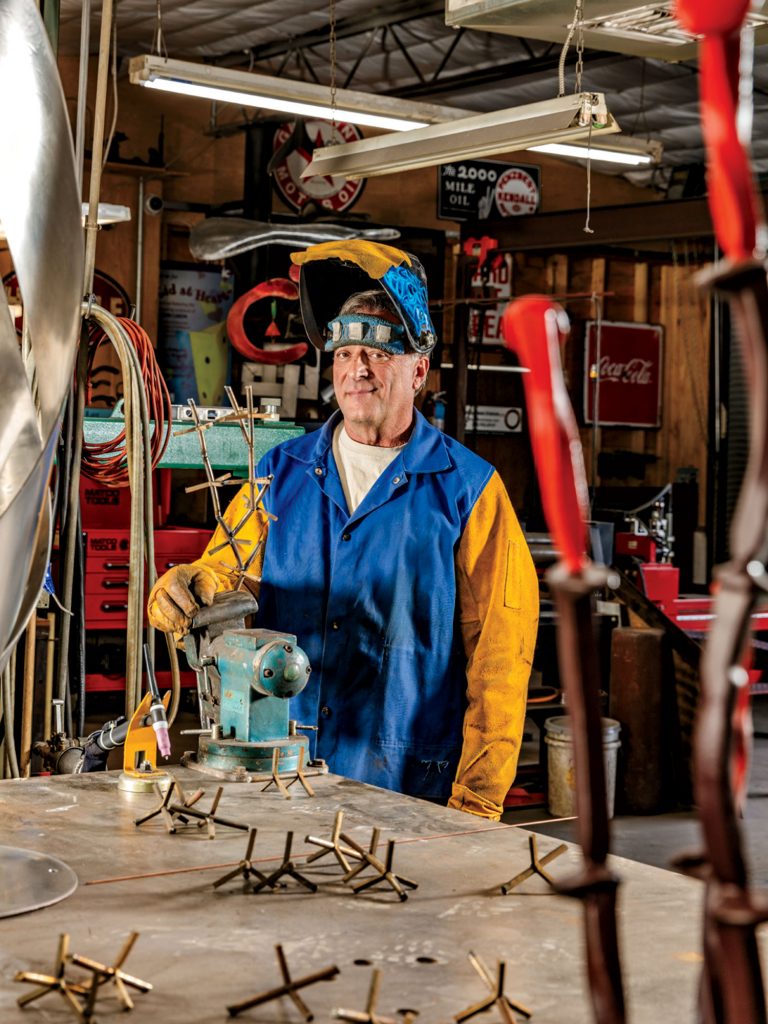
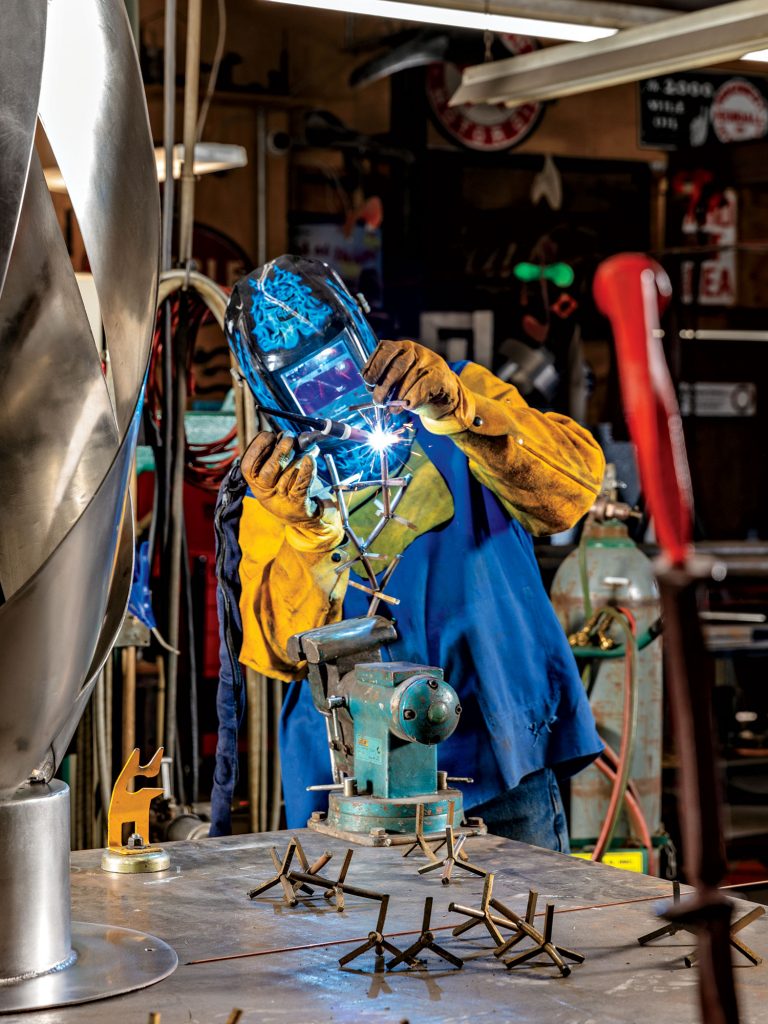
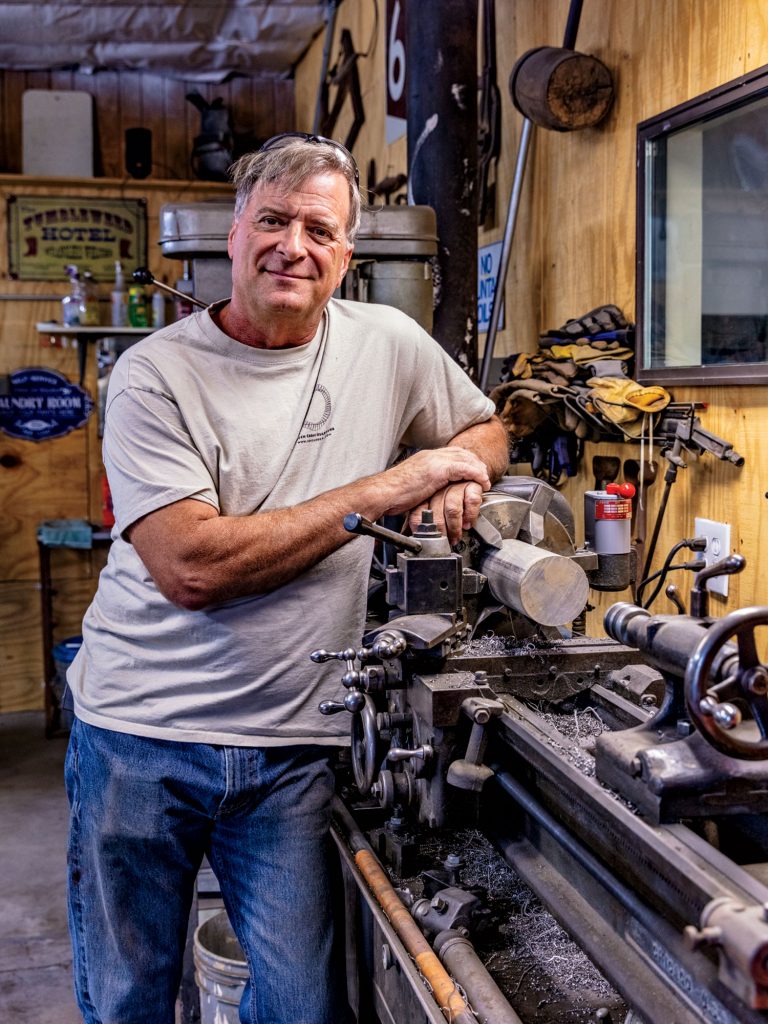
Today, Caron works out of a studio in a historic 1947 garage near Phoenix Sky Harbor International Airport. There, in a large double service bay turned machine shop hidden behind a working German automotive repair business, you’ll find him most days crafting artworks out of steel, copper and aluminum. The intimidating forms of hulking metalworking machines can be seen in the open doorways. Nearby, sparks fly as Caron, dressed in protective flameproof gear and wearing a welding helmet, fuses bits of metal together, creating fanciful shapes that seem to dance effortlessly on air despite their solidity.
His artwork—reminiscent of that of M.C. Escher and Antione Pevsner and rooted in such challenging mathematically based forms as fractals, tetrahedrons and Möbius strips—ranges from minute tabletop pieces no more than 3 inches long to jaw-dropping outdoor sculptures, often kinetic, that tower upwards of 16 feet high by 18 feet wide.
“I love optical illusions—where does it start, where does it end kinds of things,” he says. “And I’ve learned how to bring that to life in 3D. I love the beauty, the elegance of them.”
An avid motorcyclist, Caron also is drawn to the curves and twists of a long, winding road, the expression of which often comes through in his art. “A lot of my pieces are very sensual. You want to touch them,” he explains. “You just close your eyes, run your hands over them, and let your imagination wander.”
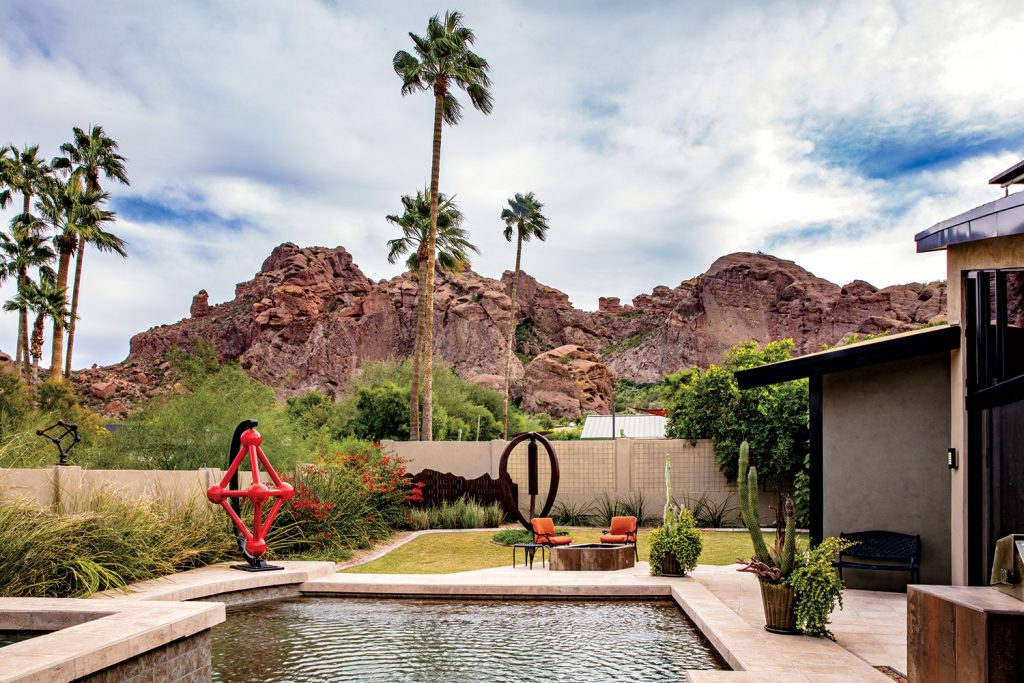
John Scacchia, owner of a 2.5-acre private horticultural garden in Bedford, New York, is one of Caron’s most prolific collectors. He has commissioned eight pieces from the artist, many of which are powder-coated in vivid hues and mimic the shapes of plants that don’t easily grow in the cool, woodland environment of the East Coast.
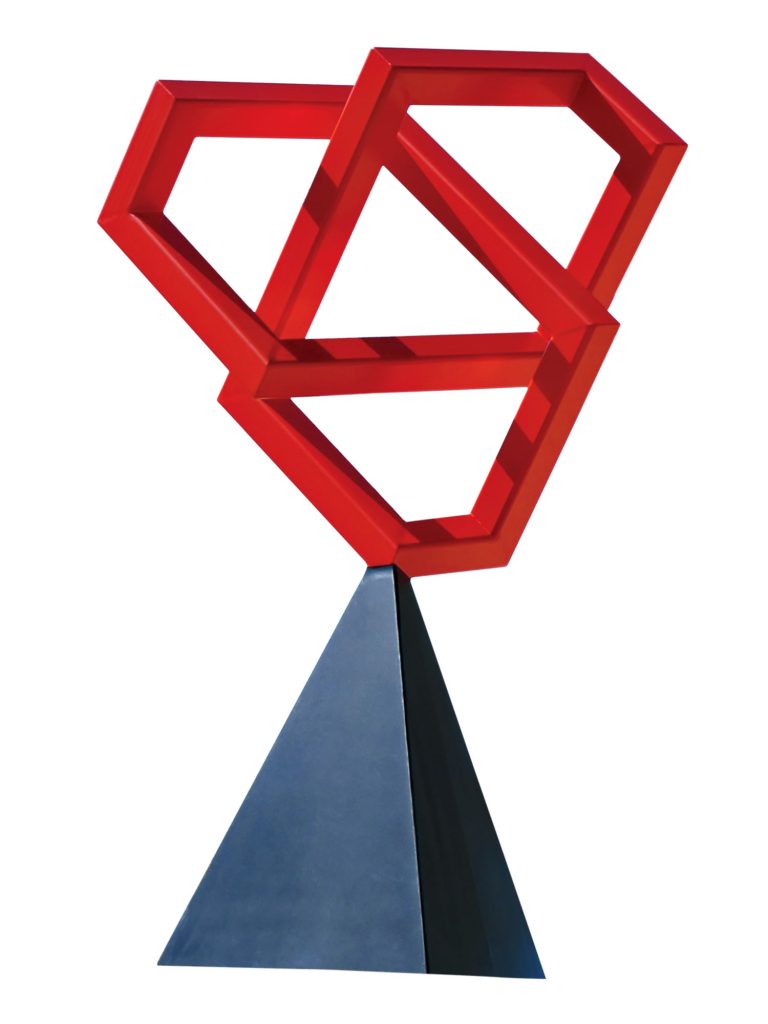
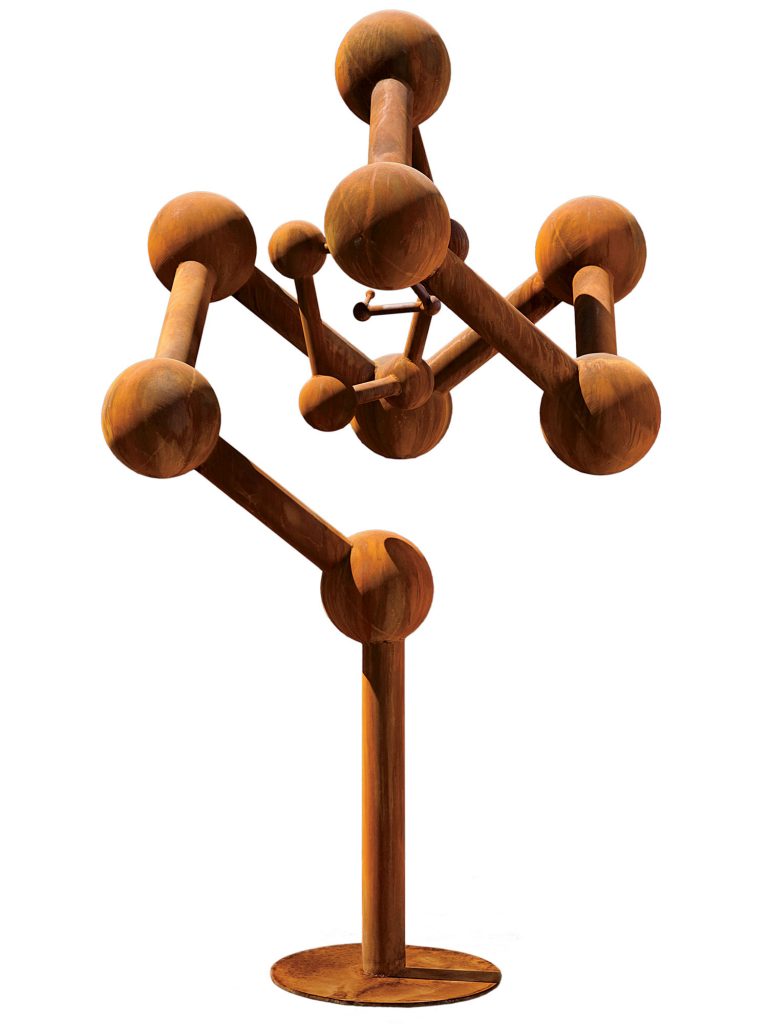
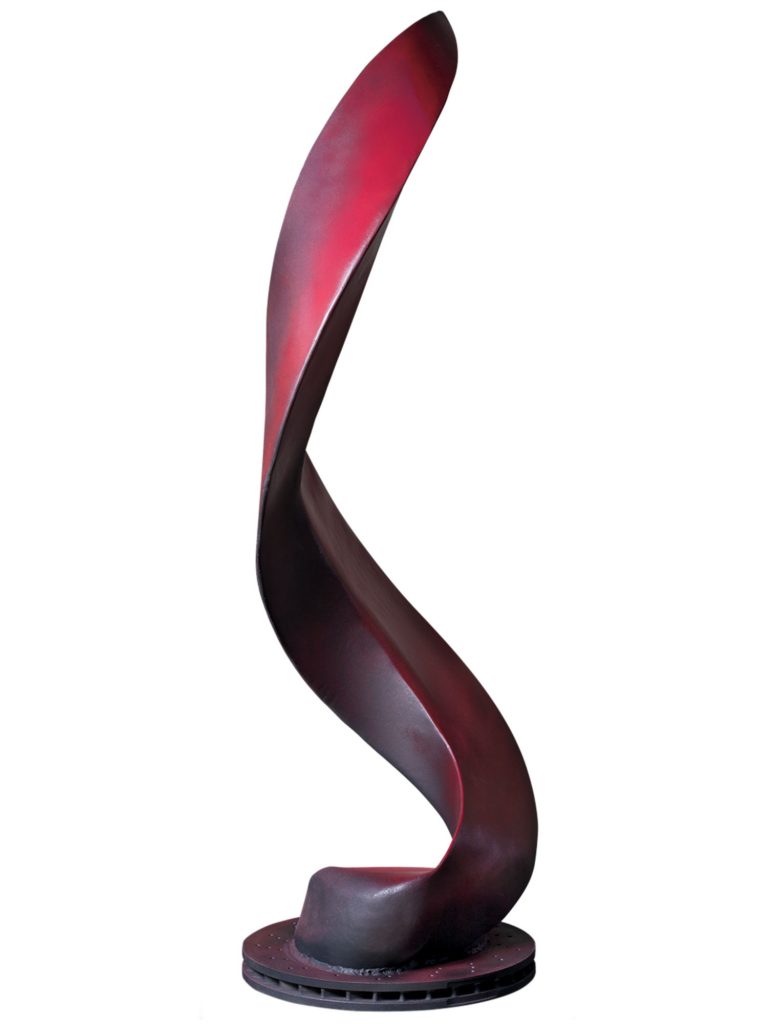
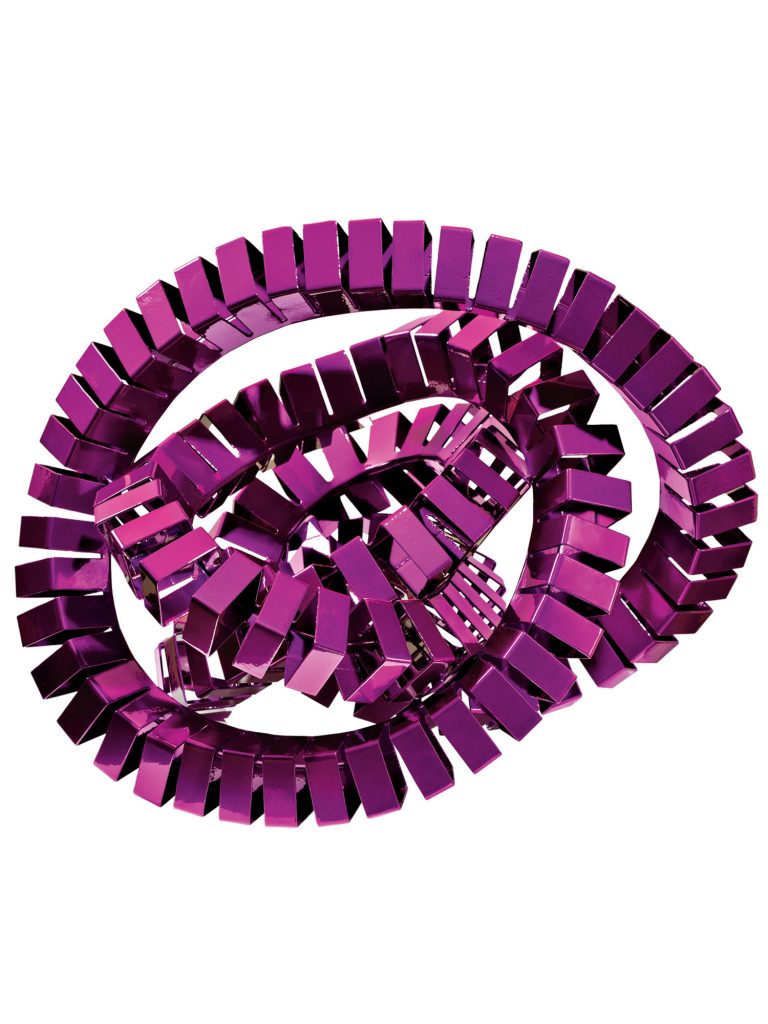
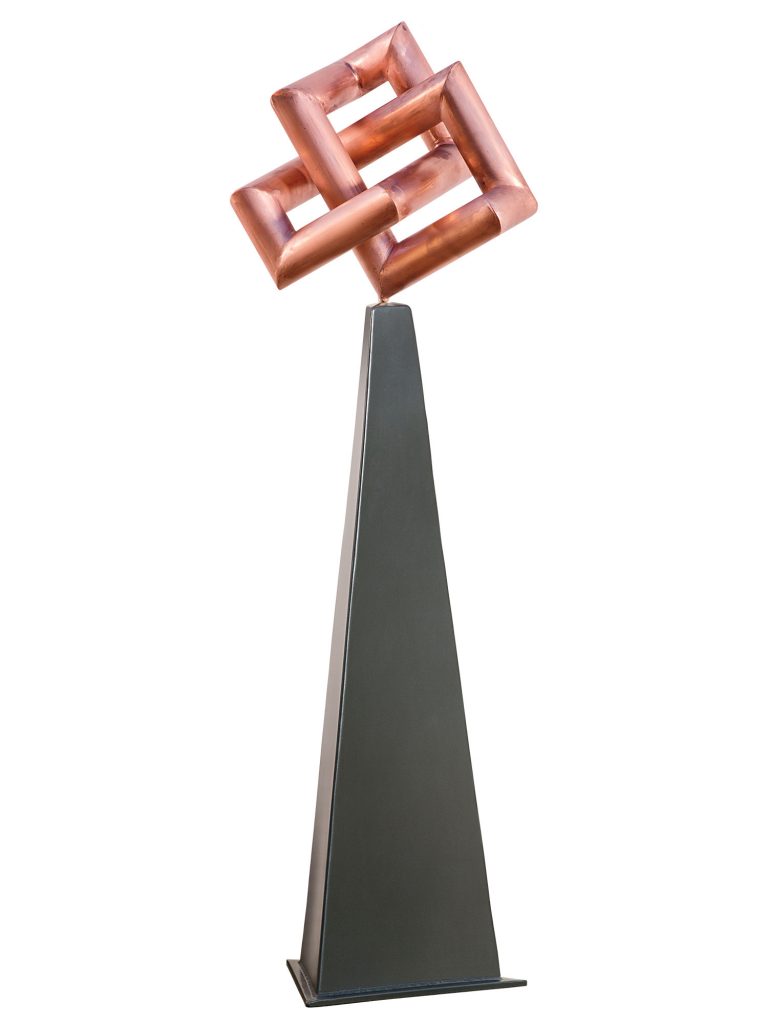
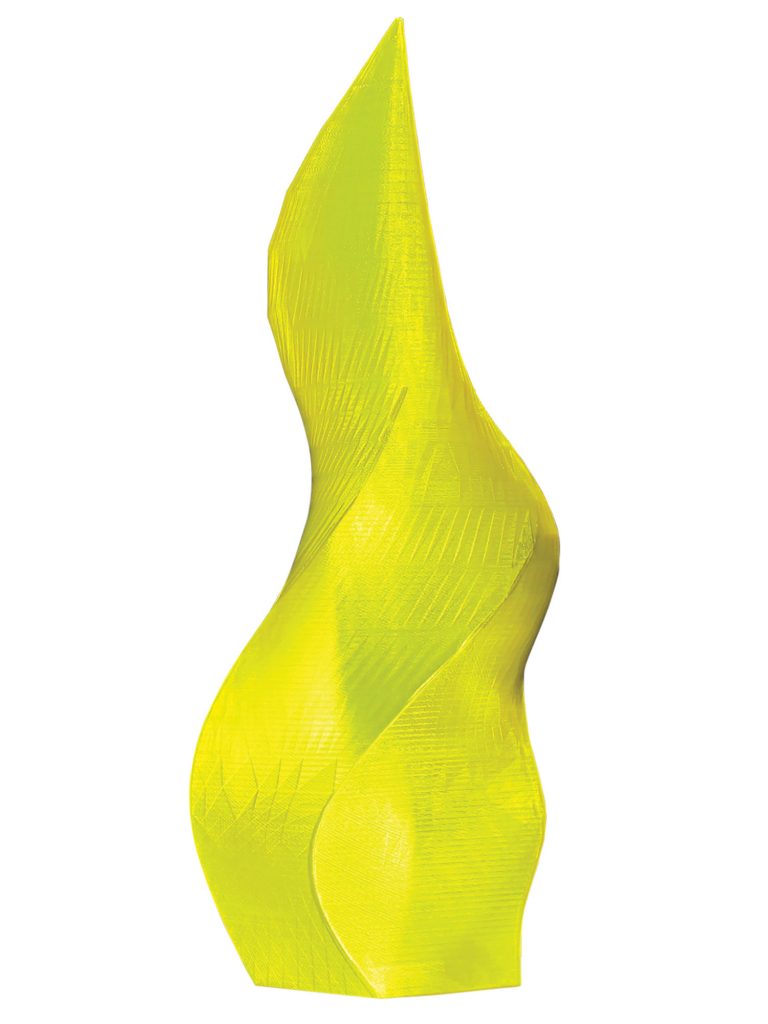
“Our relationship started back in 2012 after Hurricane Sandy came through,” Scacchia says. “I started thinking about ways to embellish my garden; I wanted a lot of vibrancy but without flowers. I was doing some research on the internet and came across Kevin,” who created a bright yellow, 7-foot-high, harp-shaped fountain that now rests at the end of a path surrounded by dense foliage.
“Part of the reason we work so well together is probably the fact that we have a common love of geometry and color,” Scacchia continues. “He’s never said that an idea was stupid or refused to listen to me. I’ve asked him to put together maybe 20 different designs, of which he’s executed eight. One of the great things about Kevin is that he’s very open to ideas and suggestion; it’s unusual to have this depth of a relationship with a sculptor.”
I love optical illusions—where does it start, where does it end kinds of things.”
—Kevin Caron, artist
For Caron, the best part of his work is seeing the reactions of his clients, whether they’re purchasing an already made spec piece or commissioning a new creation. In the back of his studio, on a wall decorated with quotes, magnets and small tools is a sign that reads, “Laugh, cry, throw rocks or throw up. It does not matter as long as you react.” The thought-provoking statement helps motivate him to continue dreaming up innovative and often off-the-wall projects. “It’s my job as an artist to touch you emotionally,” he notes. “It doesn’t matter what I think about what I create. It matters what you think about it. Are you happy? Are you sad? Do you love it? Do you hate it?”
When not cutting, shaping, grinding or welding metal, Caron continues to sculpt—but at home with the aid of one of his three 3D printers. He was one of the area’s first artists to adopt this groundbreaking transformational technology, which he did about five years ago after his brother-in-law sent him a miniature printed copy of his hand. “It was an itty-bitty thing, but the detail was amazing,” he recalls. “I thought to myself, ‘Time out, I must know more about this because now there’s a machine that can do my sculpting for me.’”
His initial printer, a Cartesian-style version that can print items about as large as a basketball, allowed the artist to make maquettes of his metalwork for models and presentation samples. “I could see if a piece was proportional, if it looked right, if it would stand up on its own,” he says. “I could take it back to my studio to get measurements and to see in what ways the steel was supposed to bend.” And instead of presenting clients with drawings, he could now show them a scale model of what he was going to make. “It opened up worlds of possibilities.”
His latest printer is a custom-designed 8-foot-high Delta-style machine, which he uses to create not just maquettes but actual artworks upwards of 4 feet tall. “I’m literally printing sculptures,” he explains. “It’s so much easier to design the weird fantastical forms I have in my mind. With 3D printing, I can make in a day or two what would take me months to create out of steel.”
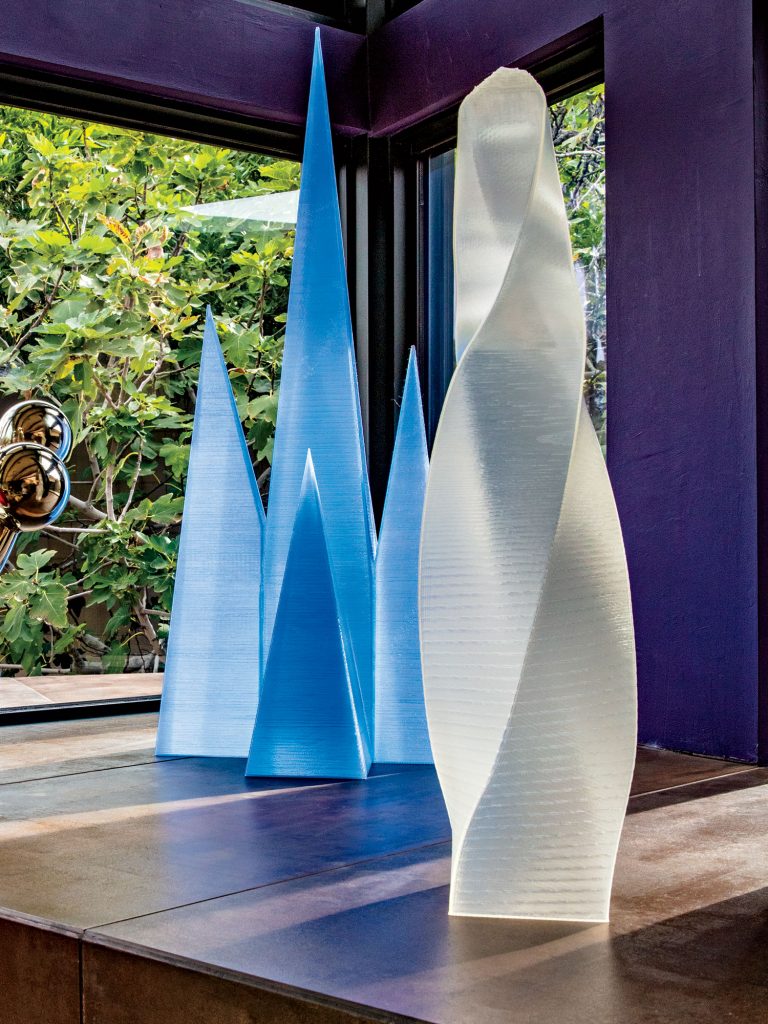
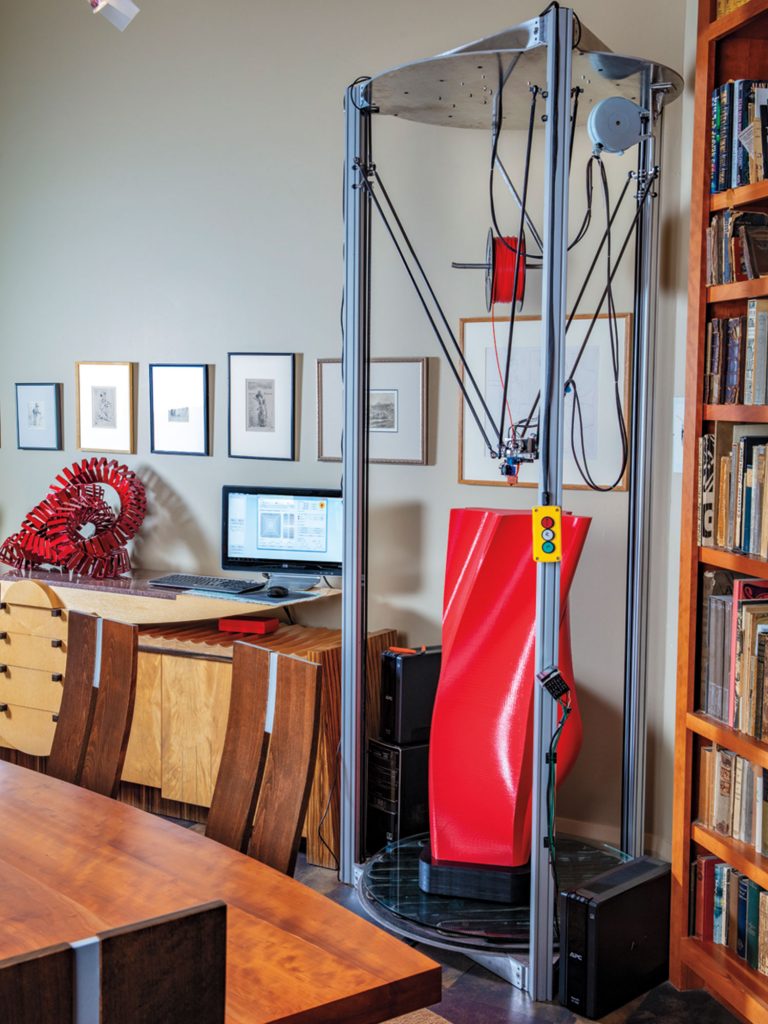
“These are one-of-a-kind, crafted sculptures,” Caron says of his new works. “The 3D printer is just another tool, even if it is a smarter tool. But the pieces still have my soul and my brain in them. I’m just not using my hands.”
The last 13 years have been a wild, sometimes wacky yet always fulfilling ride for Caron. And at the end of 2018, his hard work and creativity really paid off. In September, he was featured on an episode of ABC’s “20/20.” The segment, called “The Real Rookies,” profiled folks who had experienced career changes later in life. And in October, he was the recipient of Phoenix’s Mayor’s Art Award for Visual Art, which recognizes innovation, impact and integration. The judges noted Caron’s work with 3D printing in their selection.
He’s come a long way from that first ocotillo. “There’s something magical about this whole journey,” says Caron’s wife, Mary Westheimer, who handles the business and social media side of their partnership. “We didn’t plan this. We just work hard, try to do the right thing, and good things seem to come. But I think Kevin has earned all the luck he’s received.”
And for Caron, waking up each day and getting to “play” is an adventure he hopes never ends. “I’ve become a much better sculptor, a much better artist. I take pride in my work because I see the look in people’s eyes and hear what they have to say when they first see my sculptures, and I realize, wow, they like it, this is cool.”
For more information, see Sources.