

In Living Color: Muralist Ariana Enriquez Transforms Tempe Bike Paths into Accessible Art
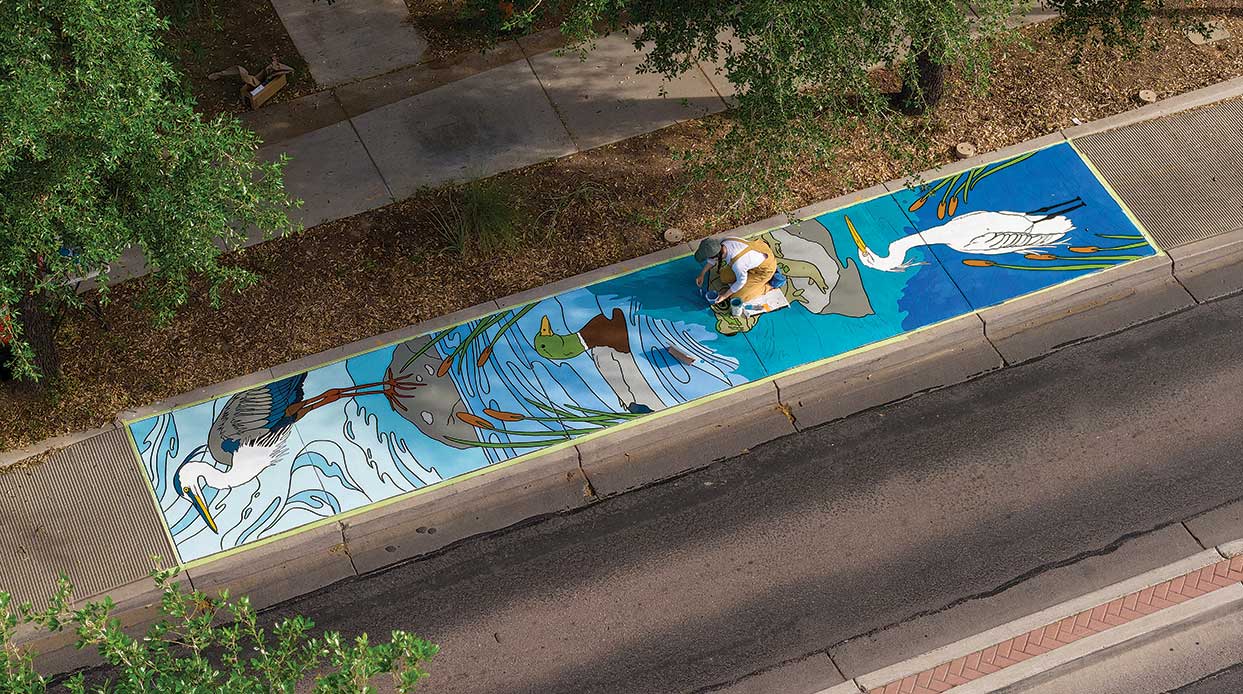
Mesa-based painter and muralist Ariana Enriquez creates vibrant, detailed depictions of the Sonoran Desert. Her polychromatic monarchs, cactus wrens, saguaros and desert marigolds embellish street corners, public institutions and private residences across the Valley.
“I had a big imagination growing up. I loved to make things, which manifested into taking art classes in school any chance I could,” she says. She went on to earn a Bachelor of Arts from Arizona State University and participated in the inaugural ASU-LACMA Master’s Fellowship in Art History. After curatorial roles at the ASU Art Museum and Phoenix Airport Museum, Enriquez established her own LLC for mural work and fine art commissions in 2022.
Her latest project is a series of bike path murals that tell the story of north Tempe’s Sunset neighborhood through the four natural elements. Each mural features colorful renderings of the community’s non-human neighbors, including great blue herons, spadefoot toads, gray foxes, Anna’s hummingbirds, brittlebush blossoms and chuparosa flowers. “My background in caring for art collections informs the ways I approach my mural work in terms of the materials I use, and in considering an artwork’s longevity within our harsh but beautiful desert environment,” Enriquez says.
Much of your work celebrates native flora and fauna. Do you see your art as a form of environmental advocacy?
I do, in that it raises awareness of the native species that we have the privilege of sharing our desert home with. I want my work to inspire people to live in reciprocity with the land and have an appreciation for what the desert provides us. There are so many incredible species we can see here by simply paying more attention to our surroundings. By painting these species, I hope to encourage others to intentionally keep an eye out for them next time they’re outdoors.
How has spending time observing the natural world changed the way you see urban environments?
Although urban environments encroach on the natural world, I am realizing the ways that the natural world adapts and ultimately reclaims the environment in powerful and inspiring ways. Desert species are particularly resilient, and witnessing this makes me mindful of the ways I can strive to be resilient as well.
Tell us about the Tempe bike path project from concept to completion.
The Tempe bike path project came about after the Sunset neighborhood received a Maryanne Corder Neighborhood Grant through the valiant efforts of artist and neighborhood resident Kendra Sollars. This grant was initially created in 1994 to invest in community-initiated projects designed to enhance the quality of life throughout various neighborhoods in Tempe. The purpose of this particular project was to raise safety awareness for the four bike paths along the narrow stretch of Fifth Street, while also contributing to neighborhood beautification efforts. The four murals were painted over the span of two weeks.
This was my first time painting murals on the ground, and I underestimated the toll it would physically take on my body. After working 10-hour days, it gave me a new appreciation for what my body is capable of, and how important it is to care for it along the way. Although challenging, the project’s positive reception from residents was a huge motivator.
How is designing a mural for people moving through it different than creating one intended to be viewed from a stationary position? What has this project taught you about the connection between community, movement and place?
It forces me to rethink compositional qualities of the design. Knowing that all visual elements will be taken in fleetingly, I chose repetitious forms and vibrant colors that will lend nicely to a cyclist’s journey, and not be disruptive of their ride, but to instead add a point of interest to the commute.
Public art has a pivotal role in placemaking and orienting us to our environment. This project has taught me that there is a flexibility in the ways we interact and take in art, and whether those interactions are stationary or on-the-go, art continues to be impactful. This project also meets people where they are, whether that be on bike, bus or foot, as a sort of visual companion. Through neighborhood projects such as this, I continue to learn how invaluable community feedback is in shaping the murals I create, and how collaborative components to art-making result in successful outcomes.
What role do you think public art plays in shaping people’s perception of shared spaces? What does it mean to create art that becomes part of someone’s daily routine or commute?
Through its accessibility, public art serves as a point of community connection and pride. It invites people to become stewards of the artwork, taking part in a shared ownership of it. I think public works in shared spaces also encourage presence, which becomes increasingly more meaningful in a world full of distractions. Creating art that becomes part of someone’s daily routine feels special because you’re adding visual interest to the human experience and contributing in small yet memorable and important ways. Since public art can also be experienced outside of traditional environments such as museums or galleries, it reaches broader audiences. This allows the opportunity for repeated interactions that inspire reflection, conversation and community change.