


Spanish Colonial: A Look into This Classic Southwest Architectural Style

The history and enduring appeal of one of Arizona’s most timeless architectural styles.
By Michelle Jacoby | Photography by Michael Woodall
With its rich history and distinctive features, Spanish Colonial architecture remains a beloved style in the Southwest—particularly in Arizona, where countless examples of it can be found throughout the state.
“The Heard Museum, Wrigley Mansion, Royal Palms Resort and Brophy Chapel are just a few iconic structures that evoke this distinct style of architecture,” says architect Michael Higgins. “You can even see it throughout historic Phoenix neighborhoods, including Encanto-Palmcroft along Palm Lane.”
If anyone could proclaim to be an authority on Spanish-inspired architecture in Arizona, it would be Higgins, whose design of the “House of 100 Arches” essentially put him on the map as a formidable expert in the field. Located in Scottsdale on former horse property, the home is a study in this architectural style, exhibiting all the hallmarks that define it.
It was the first home Higgins designed in this style, and he has continued to be enamored with it throughout his career. “I studied and got licensed as an architect in California, where the style is so prevalent, particularly with the Spanish missions,” he says.
But it was California architects—such as Wallace Neff and George Washington Smith—who truly paved the way. “Smith designed Casa del Herrero, the ‘House of the Blacksmith,’ in Montecito. It is perhaps the most famous Spanish Colonial home in America,” Higgins notes. “But what some people may not know is that he also designed the Immaculate Conception church in Ajo. It’s his only Arizona structure.”

Other prominent architects began designing in this style, creating buildings that became iconic in California. Sumner Spaulding and Walter Webber designed the Catalina Island Casino, which melded art deco and Spanish Eclectic design, while Bertram Grosvenor Goodhue was the lead architect for the 1915 Panama-California Exposition located in San Diego’s Balboa Park.
“A few years later, Santa Barbara experienced a devastating earthquake and lost many of their public buildings,” Higgins says. “The city was rebuilt essentially in this style, which is why you’ll often hear it referred to as Santa Barbara style.”


Spanish-influenced architecture began making its way to Arizona through several projects, notably the Wrigley Mansion. Architect Earl Heitschmidt designed the home for William Wrigley Jr., who had all the original tile transported to Phoenix from his tile factory on Catalina Island.
“Architecture in the Southwest has been shaped by both local and external influences,” Higgins explains. “In Arizona, architects, such as the firm Lescher & Mahoney, which was responsible for the design of the Phoenix Country Club, and H.H. Green, who designed the Heard Museum, have left a lasting legacy.”
While Higgins’ portfolio spans various architectural styles, he has an affinity for the aesthetic, which he describes as non-pretentious and versatile. “You can dress them up or down,” he says. “You can make them feel more European or Southwestern. They can be fancy or casual, feminine or masculine.”
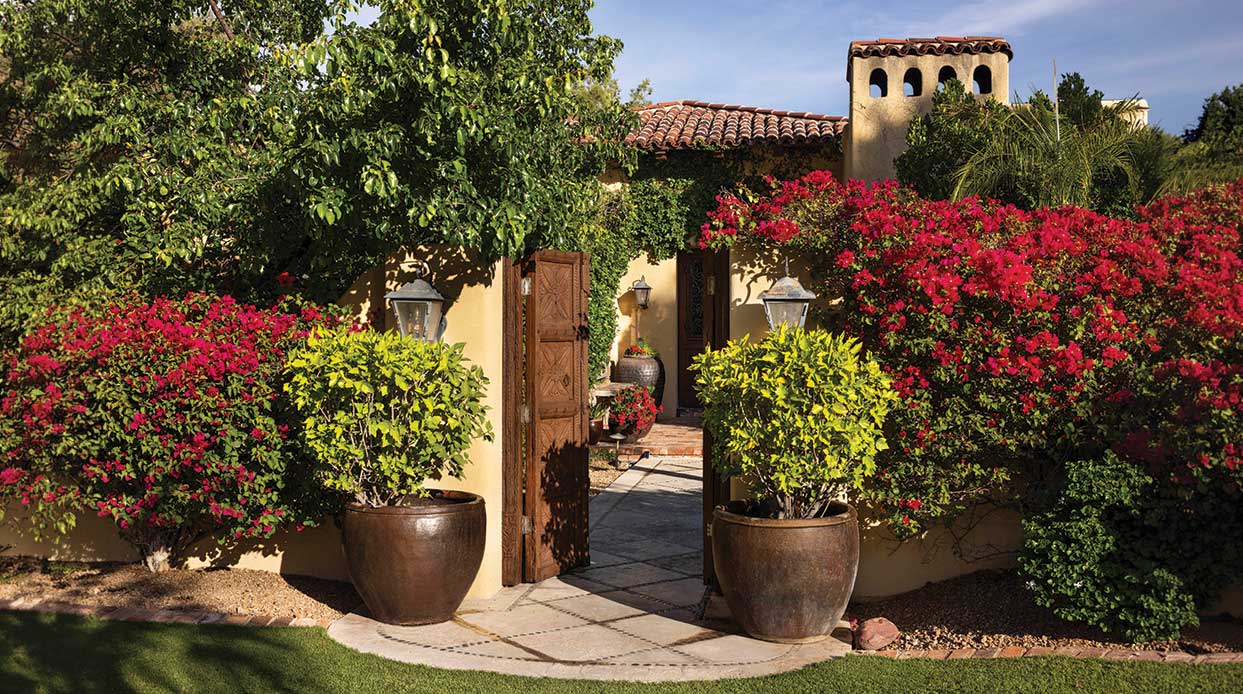
As versatile as it is, the style has distinct qualities: red tile roof made with two-piece mission clay; white stucco, either textured or smooth; deep-set windows with accented sills or no sills at all; heavily carved doors; and, of course, the arches, which Higgins says can be elliptical, segmental, round, circular or flat.
“It’s also known for walls made from stucco, but perforated with a grid or latticework that shades the windows,” Higgins says. “Additionally, we design a lot of wrought iron for our homes, including railings, light fixtures and window grills. Wrought iron is like the jewelry of these homes. These elements also produce wonderful shadows.”
Other identifying features include elaborate chimney tops; covered porches, arcades and colonnades; beams with corbels and posts in the wood; and asymmetrical facades.
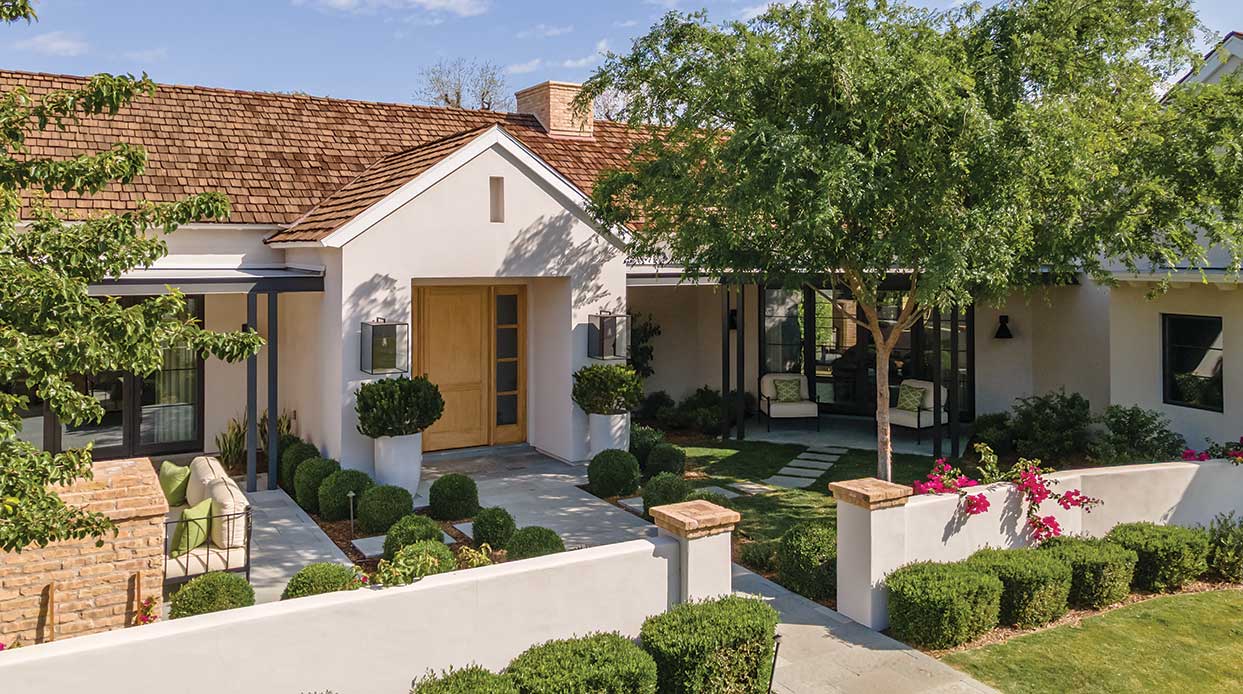
With its rich history dating back to the turn of the century, modern adaptations of this ageless style maintain its essence while incorporating contemporary trends, such as the use of simpler lines, lighter color palettes and the integration of modern materials and technologies. Despite these updates, the core elements remain, ensuring the style’s everlasting appeal.
“In architecture, design styles are often copied and reproduced,” Higgins says. “But Spanish Colonial homes have an enduring and timeless quality that can morph according to people’s personalities and tastes.”


Exposed support beams, carved ornamentation and wrought-iron accents are frequently used in Spanish Colonial architecture.