
‘Desert Mirror’ Reflects Different Views of Taliesin West
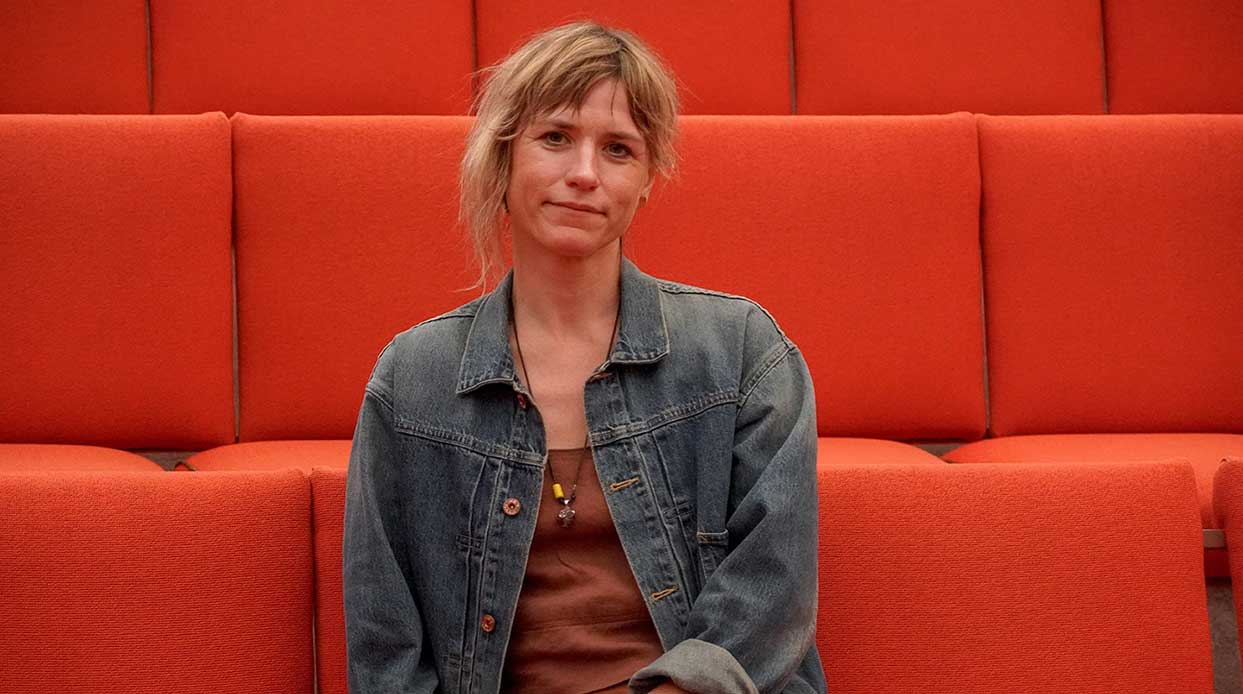
Visitors to Frank Lloyd Wright’s iconic Taliesin West generally ooh and aah at the architect’s drafting studio, his sunken cabaret or his dreamy pools. “Desert Mirror,” an exhibition by artist-in-residence Erika Lynne Hanson, asks visitors to consider unseen items, from hidden infrastructure to the rock that creates the literal foundation of the historical desert camp.
“I wanted to use Taliesin as a way to help to get people to start to think about the things that we live with, and where it comes from,” says Hanson, an interdisciplinary artist and Arizona State University professor.
The exhibition, which runs through May 31, features weaving, sculpture and video placed throughout the property. Guests can experience “Desert Mirror” as an audio tour or with Hanson on an artist-led walk on April 16.
Hanson shares more about her time as an artist-in-residency, how she creates across different mediums and why she’s into, as she puts it, “human-geologic relations.”
This exhibition was born out of a two-year artist-in-residency program. What elements of Taliesin West and Wright’s work spoke most to you?
The residency was interesting, because it’s sort of a rebirth of the residency program at Taliesin West. That was an interesting framework to start the experience, to figure out, “What is this place? What is this now? What has it been, and what can it be in the future?”
All of the rock that is used in the desert masonry—which is the name for the architecture that Frank Lloyd Wright developed for that site—comes from the 500 acres that comprise the property. The rock plays a pivotal role in what that architecture is in terms of how we build with it, but also how the architecture mimics the landscape, because it is part of the landscape. That was something that really spoke to me in terms of the work I do.
A lot of the projects I’ve been working on in the past couple years look at, for lack of a better term, human-geologic relations. What are the things that humans do with rocks, and why do we or do we not pay attention to them?
Much of central Phoenix—and much of the Valley—is concrete. But we don’t consider where that material came from. Much of that is coming from gravel pits not far away, because it’s too expensive to haul something that is so low-value. If we want to take that framework, we can think about a lot of the concrete and infrastructure as hyperlocal. But we don’t use that phrasing when we think about big infrastructural things.
Tell us about the pieces you’ve created and what visitors can expect from the exhibition.
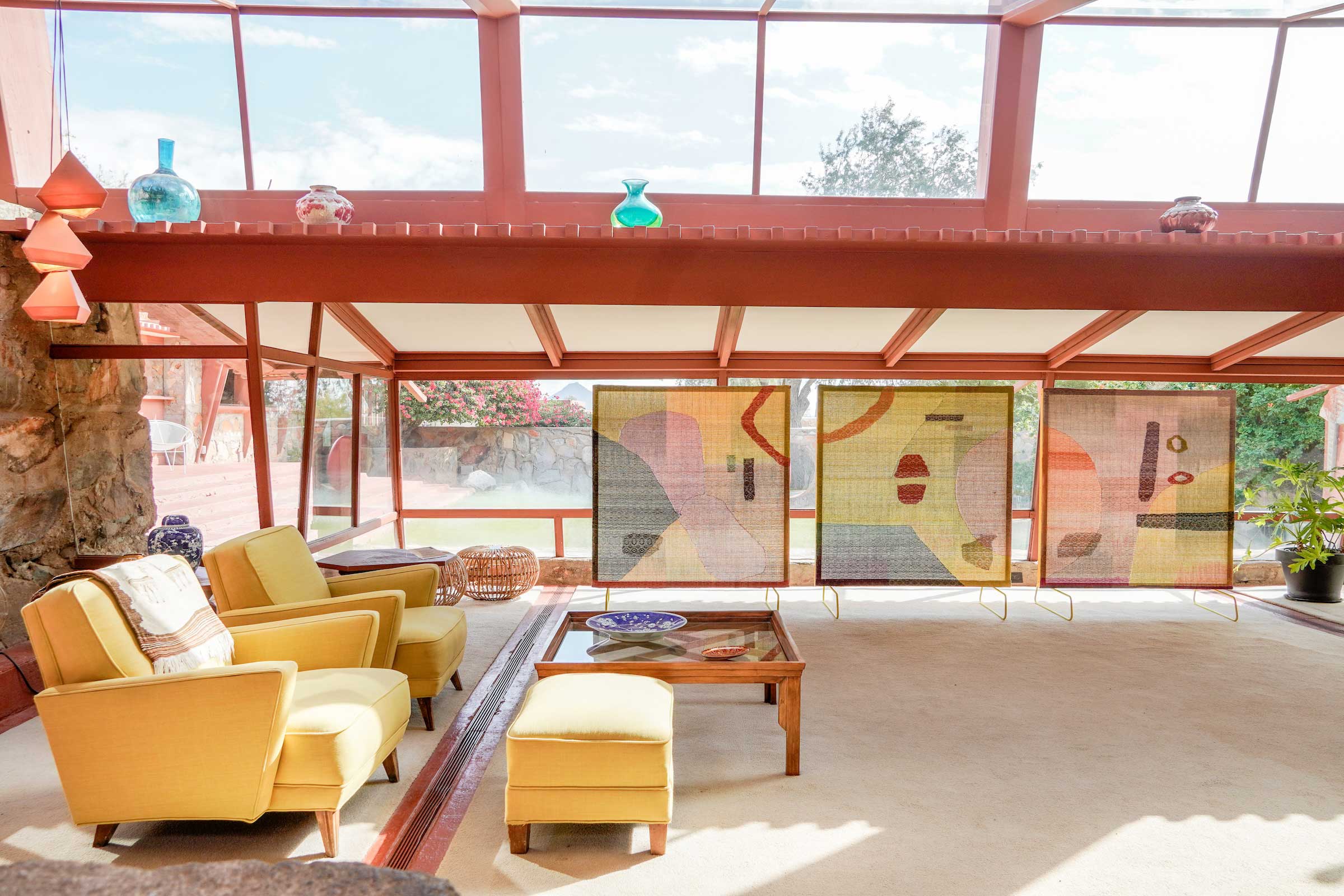
The whole project is built off the idea of paying attention to natural desert rock from the Taliesin site. Primarily, I’m a weaver, so I create textiles—through dyeing and weaving yarn—that also, in a way, function as paintings. They abstract the landscape, they abstract ideas, they abstract different feelings about the site.
The first piece that you encounter is a weaving in Wright’s office that plays with the land, the sky, the light and the infrastructure. There is also a series of mirrored pedestals that I had fabricated for this project. They are situated in corners and near the walls, so they reflect the architecture, they reflect the rock that is there and they also all hold different rocks from the site.
As the visitor moves through the audio tour, other elements start to slowly build upon that story. There are weavings and sculptures in other rooms, and in the kiva and in the cabaret, are two new videos projected on screens that would have historically shown films. Frank Lloyd Wright was a film buff. One of the things I wanted to do with the project was to reactivate some of the architectural elements that haven’t been activated recently.
Let’s talk about the inspiration behind the name of the exhibition, “Desert Mirror.”
The inspiration behind the name has to do with how we understand the built environment and the natural environment.
I was thinking about the work of Robert Smithson, an artist who primarily worked in the 1970s, who has a series of works called “Sites” and “Nonsites.” He’s taking mirrors and putting them out in the landscape to reflect what he would call a “site.” And other pieces in the museum with rocks or earth material and a mirror to reflect what you would then think of as the “nonsite,” but with those natural materials.
I wanted to play with that. It’s less about the object transforming and the way that we’ve changed the context, the way that we as humans understand them.
How did you get inspired at Taliesin West?
A lot of the time I spent up there was time walking and observing, and paying attention to what was happening there on a daily basis.
When I started the residency, they were redoing all the water and sewer pipes, which I found interesting because I care about things like infrastructure. It’s fundamental to how our cities and systems work. What are those invisible systems?
The fact that this was happening when I started working there really helped to shape the way that this project came to be—a parallel to larger urban environments. It was interesting for me to see them digging up sewer pipes and then realize that the project would shift or change because of an unknown.
What does your process look like? How does it shift depending on the medium?
Most of my work is larger, research-based projects where I’m looking at a site. I try to understand the complexity of the things I’m thinking about, and to try and address through different media and different mediums. They all have different levels of abstraction, and they all take different amounts of time to make.
This project came into being when I imagined multiple video pieces, sculptures and then weavings. They all start to talk to each other, and they help to form and round out the project in a way that one single media couldn’t do on its own. It’s really about them being in dialogue with one another.
They also engage different parts of the brain. It helps to be working on these pieces simultaneously to help to figure out how they complement each other.
On April 16, there will be a special event that includes a tour as part of architecture week. Tell us what’s in store.
The goal for that event will be an alternative infrastructure tour, where we will explore the property and sites that show the past and present sources of water, electricity and energy. Getting people to see outside of Taliesin’s historic core and understand the site as a moving, working, breathing, living place.
If Frank Lloyd Wright could see this exhibition, is there one thing that you’d be most excited for him to see, or to tell him about your experience?
I would be interested in having a conversation with him about his ideas of organic architecture and have a dialogue about the way that he was interested in those spaces and how the architecture is in direct dialogue with the landscape. I would be interested in some of his ideas about what that means.