


Flagstaff Honors Artists of Color With Powerful Outdoor Sculpture Exhibition
Valley visitors taking a respite from the heat up north can stroll through a new public art installation in Flagstaff. This is the second time the city has featured artists of color with this multicultural sculpture exhibition. Five pieces are immersed in the two-acre Elizabeth “Liz” C. Archuleta County Park, located at 703 E. Sawmill Road.
“The interaction of art and nature that occurs in this exhibition is not an afterthought,” says Beautification, Arts & Sciences Program Manager Jana Weldon. “It is a central engagement and essential dialogue.”
Weldon shared more about the artists, their work, and what she loves about art in public spaces.
The exhibition is free to attend, and works are on display through March 15.
Tell readers about how this exhibition came to be.
From my start with the Beautification, Arts & Sciences program, we brainstormed on projects for greater visual representation of differing and underrepresented communities, which coincided with the desire of the Indigenous community for more visibility. Ideas take time and we vetted a few with Rose Toehe, City of Flagstaff Administrator for Indigenous Initiatives, that didn’t come to fruition.
My 25-year experience in public art gave me the background to know the success of changing three-dimensional art exhibitions, especially how well they support artists on an annual basis (rather than a one-and-done), and how outdoor exhibitions bring fine art to the community where they are.
As I came to know Flagstaff, I found Liz C. Archuleta County Park, which has a multicultural and nature theme, and five sculpture pads that Coconino County envisioned using for changing exhibitions but did not have the staffing or financial resources to realize. The threads came together.
Tell us about the artists who are represented.
For this second exhibition, in alphabetical order, we have two artists from the first exhibition, Olivero Balcells and Lance Yazzie; and three new artists, Isaac Caruso, Joe Ray and Adrian Wall.
Oliverio Balcells is a multidisciplinary artist whose practice includes painting, music, murals, mosaic art, photography and being a teaching artist and a scholar of the ancient Mesoamerican cultures. He is interested in social themes like history, culture and symbolism and is inspired by color, nature and music. The essence of his artwork expresses the energy and personal passion that is reflected in a song, a painting or a public art project.
Isaac Caruso has painted murals across the world, from Norway to Uruguay. He is the published author of the first children’s book created entirely with murals. Lately, he has started sculpting work for Valley Metro, Phoenix Office of Arts and Culture and now the City of Flagstaff. He is a Northern Arizona University alum ,and Flagstaff holds some of his fondest memories and most inspiring moments of his life. Isaac makes public art to communicate with communities and to transform his surroundings with positivity.
Joe Ray is a public artist, visual artist, creative director, illustrator and storyteller based in Scottsdale. He is an instructor at Arizona State University’s Herberger Institute for Design and the Arts. Joe’s vibrant, bicultural perspective, shaped by the Arizona and Mexico regions, is reflected in his work, which has been exhibited and published throughout the U.S. and Mexico. Known for its evocative color and passion, much of his art incorporates cultural iconography, filled with vitality.
Adrian Wall is a stone sculptor and musician from Jemez Pueblo in New Mexico. He has been carving since his late teens. Adrian is influenced by the Native American art sculpture movement created in the American Southwest and is fascinated by faces and form, often incorporating these elements into his sculpture work. His latest artistic obsession is carving in hard stones like granite and basalt. Adrian is also an accomplished musician.
Lance Yazzie resides on the Navajo Nation in Tuba City. He grew up around art and began sculpting at the age of 14. Indigenous teachings and designs are common themes highlighted in his sculptures, and he conveys many messages and emotions through the varied textures and symbols in his artwork. His sculptures can be found in collections throughout the Southwest.
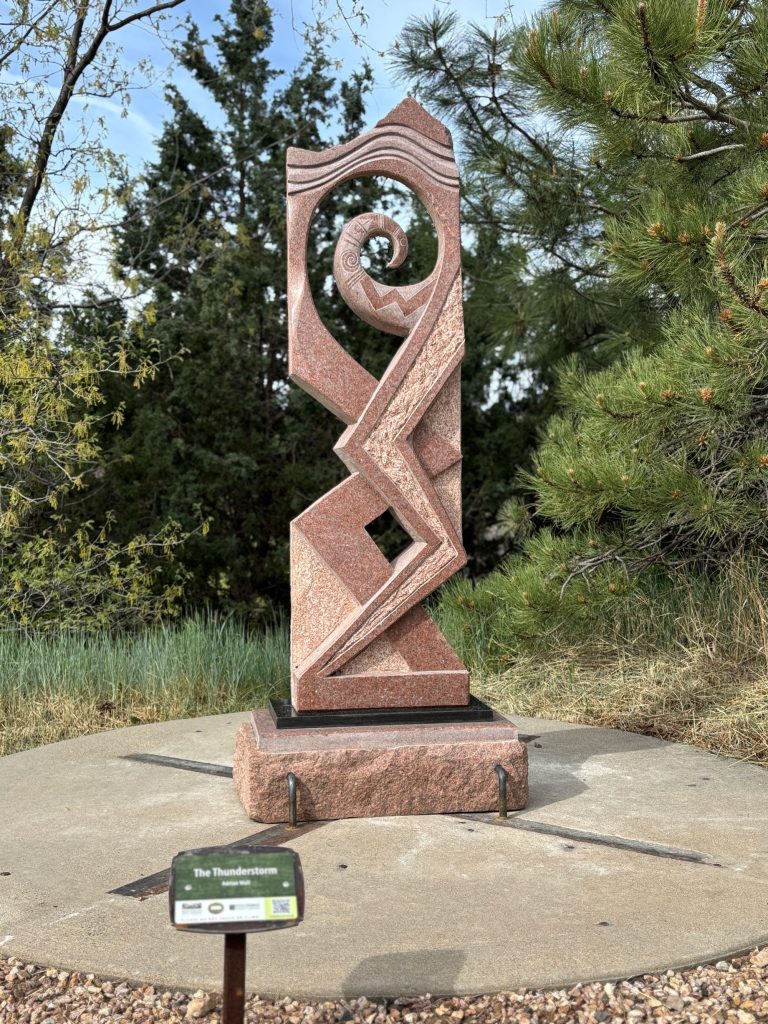
“The Thunderstorm” by Adrian Wall 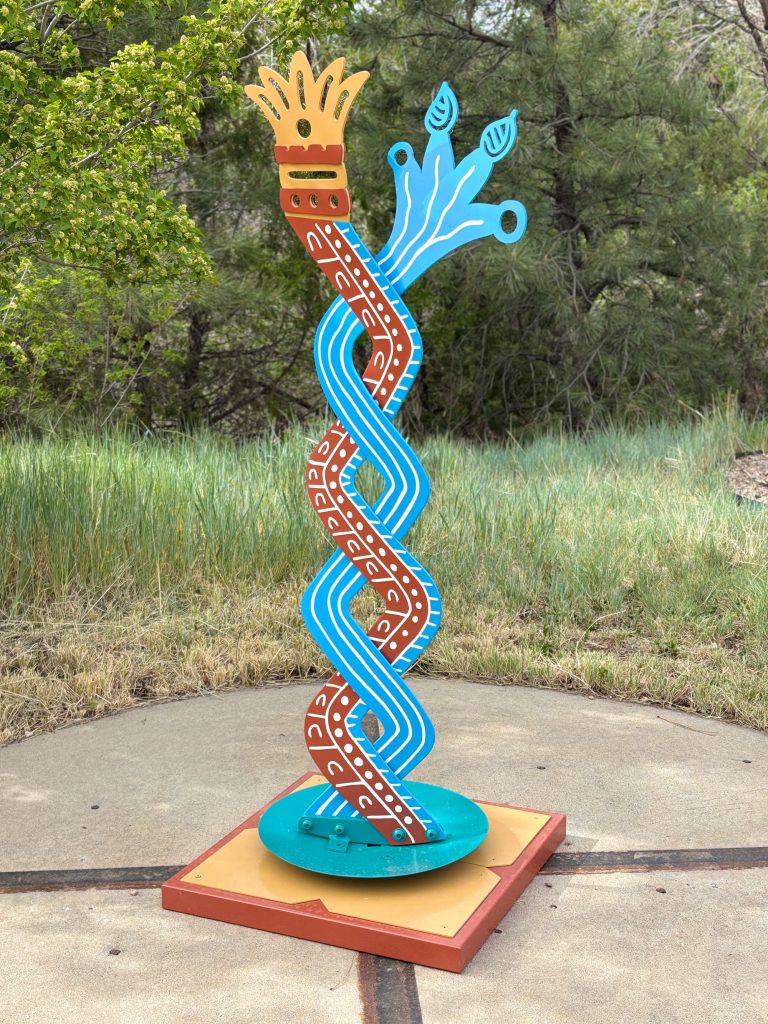
“Atl-Tlachinolli” by Oliverio Balcells
Tell us about the works that were selected.
The artworks are valued for their artistic accomplishment, speak through cultural iconography and have a deep connection to the natural environment—especially the skies, with its storms, seasons and its stars—that is reflected around them. Though temporary, all must withstand the outdoor environment of Flagstaff. Thus, we see stone and steel the most, though this year we have a pine wood sculpture.
“The Thunderstorm” by Adrian Wall is made of granite and reflects on storms. Adrian relates, “I have been working on a body of work in granite that reflects my interest and activism in issues around climate change and Indigenous sense of place. I feel that storms are becoming more powerful due to climate change. I feel it is also important to instill in my sculpture what I’ve learned from my culture about our reverence for the rain. Many of the designs we use in our ceremonial regalia and art reflect the importance of storms in our culture.”
Another stone sculpture is “Asdzą́ą́ Nádleehé (Changing Woman)” by Lance Yazzie about a Navajo deity who is believed to reside at the San Francisco Peaks. Changing Woman is responsible for creating the first four Navajo clans that have been passed down matrilineally. She is also believed to have been responsible for destroying the monsters by giving birth to the hero twins who fought the monsters. This sculpture incorporates the spirit animals of the four clans, and it also references the Hero Twins who destroyed the monsters and, afterwards, transformed into the eagle and the owl.
“Celestial Juggler” by Joe Ray, made of powder-coated cut metal, is part of the artist’s “Time Travelling Ancients” series, featuring pre-Columbian deities and priestly figures who journey to the 21st century to experience the Chicano/Latinx bicultural world. These time-traveling figures are intrigued by modern culture and eager to connect with their descendants. The artwork depicts a modern incarnation of an Aztec Tlamatini priest, whose role is to chart the heavens. He juggles planets, symbolizing the blend of ancient wisdom and contemporary knowledge. Drawn to Flagstaff’s renowned astronomical research and commitment to preserving dark skies, “Celestial Juggler” bridges the past and present, celebrating the timeless pursuit of understanding the cosmos.
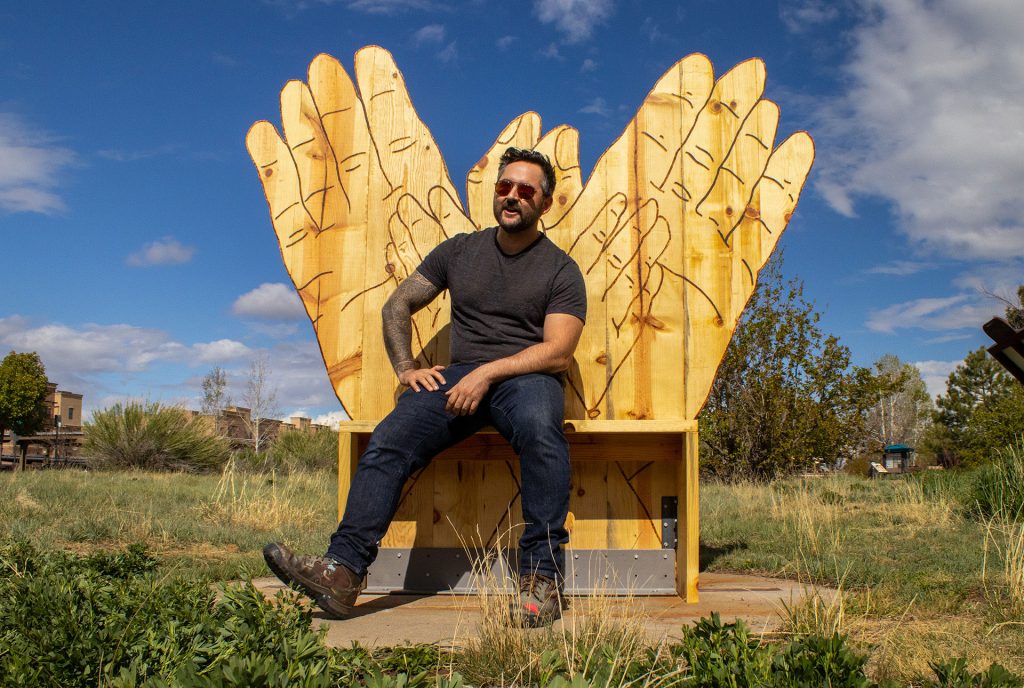
A structure made of reclaimed Ponderosa Pine from the Coconino National Forest, “Wings of Ancestors” by Isaac Caruso, is cut into the shape of two sets of hands, one young and one old. They come together to create the shadow puppet of a bird. This shadow provides a playful shelter from the sun and is succeeding in garnering park visitors to sit in the embrace of the guiding hand that the older generations bring to our lives.
“Atl-Tlachinolli” by Oliverio Balcells is another powder-coated cut metal sculpture whose design is from the ancestral Mesoamerican tradition. It represents the moment when the rainy season meets the dry season. It is the astronomical symbol of the passage of the sun through the zenith, expressing the natural duality of a band of water and another of scorched earth. The objective of this piece is to preserve the astronomical concepts of ancient Mexican cultures.
How do you recommend visitors experience this exhibition?
The Liz C. Archuleta County Park is a smaller park with the Willow Bend Environmental Center and one main trail through the park on which to encounter the five sculptures. Morning and evening walks will capture the hand puppet shadow fun of the Carusa sculpture best. Many locals enjoy walking their dogs through the exhibition.
The park is also the link to the Flagstaff Urban Trail System, 59 miles of interconnected non-motorized pathways. Thus, a walk through the exhibition can begin a great Saturday hike. The interaction of art and nature that occurs in this exhibition is not an afterthought; it is a central engagement and essential dialogue.
Is there a work that you connected with most?
I have a strong relationship with all the works in both the first and second exhibitions for different reasons. The quality of work has been so exciting. I am thrilled to see the continuing conversation between the exhibitions that has occurred by having Lance and Oliverio return with new works this year. The past and present are linked.
“The Thunderstorm” by Adrian Wall resonates deeply with my own childhood. Growing up in the desert, rain and storms are special, a celestial event. I nearly always go puddle splashing when it rains, still to this day. And given that when I presented the exhibition idea to Rose Toehe at the park, the idea was blessed with rain, the resonance of a storm is particularly strong. Overall, each piece is made even stronger by the connections with nature and with each other. Come see!
Go to flagstaff.az.gov to learn more.