


Tour a Paradise Valley Landscape That is Both Soft and Structured

Panoramic vistas inspire a Paradise Valley couple to create an outdoor living space that softens the boundaries between structured and scenic.
By Wynter Holden | Photography by David B. Moore

Some home buyers overlook a prime location because of a few cosmetic flaws, while others can see past the peeling paint and cracked walls of a house built in the Nixon era. For one California transplant and her husband, the decision to purchase a 1969 Paradise Valley adobe horse ranch and scrape the 2-plus-acre plot down to bare bones was easy: The land spoke to them. “It’s a sweet piece of property,” says the wife, who was drawn in by the scenic views of Mummy Mountain and the tip of Dixie Peak in the Phoenix Mountains Preserve. “You would never know that a sprawling metropolis extends as far as the eye can see.”
The homeowners contracted landscape designer Jeremy McVicars, to create a low-water desert garden that would meld seamlessly with the sleek lines and cantilevered roofs of their newly constructed contemporary dwelling. The result is a study in balancing the wild and unfettered nature of the desert landscape with the sharp, exacting shapes of a modern build. “We like to follow the architecture of the home, so we built grids and lines of plants from that,” McVicars says.
At the front entrance, pristine rows of lush grasses and silvery-green agaves stand in regimental formation, guarding over a century-old saguaro tucked into a walled bed. Desert grasses are slow-growing, McVicars says, which makes them ideal for xeriscaping. “It’s not just about the water impact, it’s also the energy that goes into maintaining it. You have to trim a hedge every week, but grasses only a few times a year,” he explains. While most of the grasses on the property fade to brown in the cooler months, a perfectly spaced row of muhly grass (Muhlenbergia capillaris) in the backyard turns a dusky shade of pink each fall.

Retractable glass walls in the home’s kitchen lead to a serene outdoor dining area overlooking the pool, framing an unobstructed view of Mummy Mountain that could easily inspire a landscape artist’s masterpiece. Tucked into every alcove, crevice and planting bed are verdant vignettes replete with cacti, low-growing grasses, willowy palo verde trees and hardy succulents such as crimson-tipped ‘Fire Sticks’ (Euphorbia tirucalli). “The gardens contribute to a sense of calm; it’s a very soothing place to hang out,” the wife says.
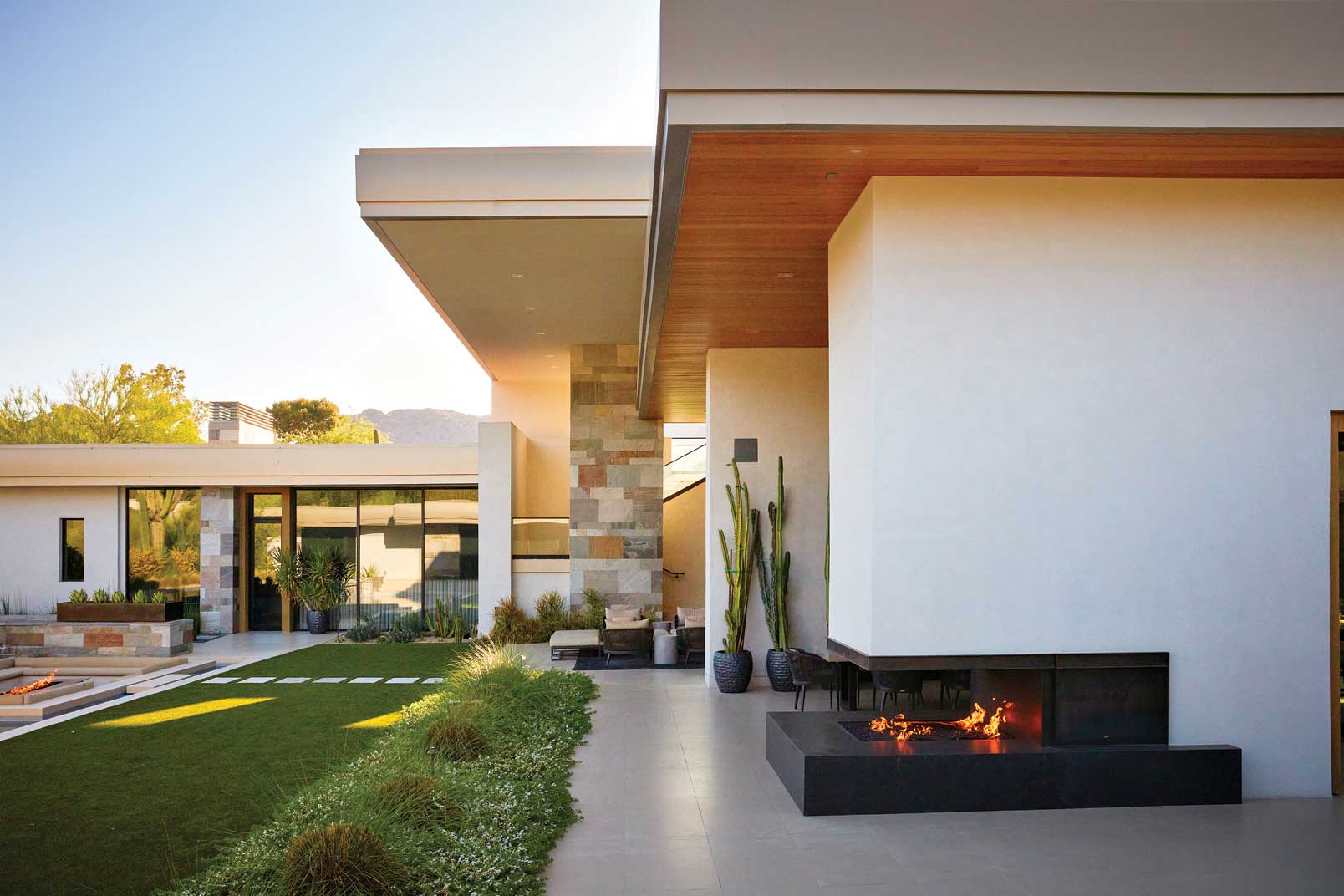
A step path over artificial grass leads to the large rectangular lap pool where her husband finds his Zen moments. An inset entertaining space with seating and a fire pit is sunken into the space, creating the illusion of floating in a tranquil sea. “We wanted to make it feel like you’re surrounded by water without actually being in it,” says McVicars, who collaborated on the pool and fire pit design. “It’s a really unique experience.”
Another of the home’s more unusual architectural features is a semi-enclosed rooftop deck overlooking the rolling desert hills to the west and north. Here, McVicars planted pencil cactuses around the perimeter to soften the space without blocking the million-dollar views. A custom drainage system that captures rainwater provides an eco-conscious addition to the drip irrigation used throughout the gardens. “It’s hard to get water up there, so working with the builder, we created a system to get plants there so it didn’t feel too dry and stark,” says McVicars.
Appointed with a cozy fireplace and seating area, the terrace is an extension of the garden and a poignant reminder of why the couple chose to relocate to Paradise Valley. While some gardens are created to provide an oasis that distracts from the hustle and bustle of city surroundings, these homeowners knew they had already found their slice of paradise. “We’re very fortunate to be in this space,” the wife says, looking at the dusk sunset casting a purple-pink light on the preserve. “I know how lucky we are to be here and have this view.”