


Tools of the Trade: How Cosanti Crafts its Iconic Sand-Cast Bronze Bells

A look at the intricate process behind crafting Arizona’s iconic Cosanti windbells.
By Nora Burba Trulsson | Photography by Rob Ballard | Styling by Len Loria
In the 1950s, when architect Paolo Soleri established Cosanti, his Paradise Valley home and studio, he crafted ceramic windbells to bring in extra money. He soon added bronze bells to the repertoire, establishing foundries at both Cosanti and Arcosanti, his experimental community near Cordes Junction. Today, sculptural Cosanti windbells—which take artisans more than a dozen steps to complete—have become a lasting symbol of Arizona design.
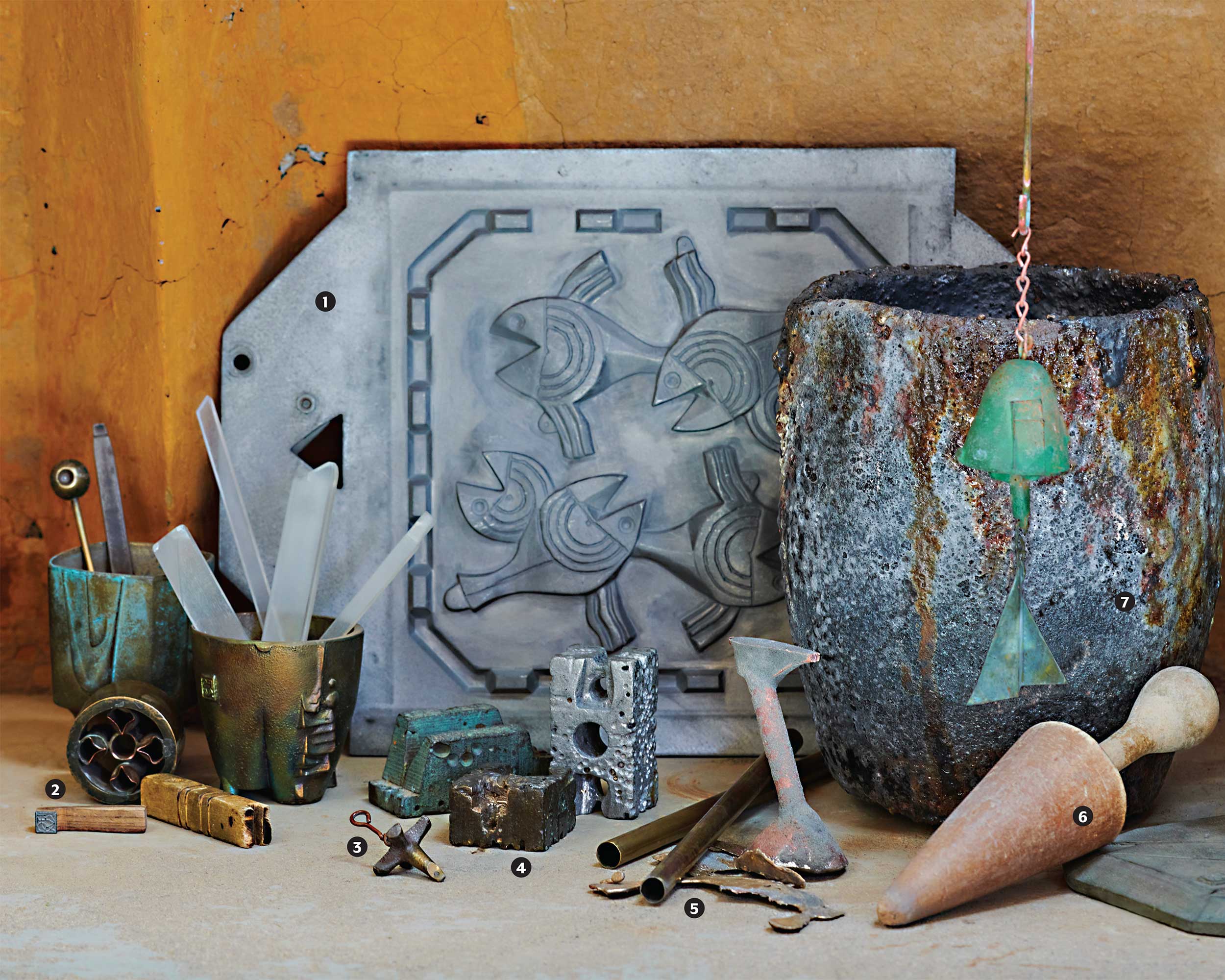
1 The match plate is a mold for sculptural elements that go atop some designs.
2 Various implements, including metal files and acrylic shards, are used to design and assemble the windbells. At the bottom left, a hallmark stamp denotes a Cosanti original.
3 This small metal tool assembles the clapper, which sounds when it strikes the bell’s lip.
4 Cast-metal drilling jigs make it easier and more accurate to drill various components.
5 Brass tubes make a sprue, through which molten bronze is poured into the mold. Upon completion, the Z-shaped sprue, which sits atop a scrap of bronze, is clipped off and re-used to condition the molten bronze.
6 Artisans utilize a wooden mallet to densely pack sand to form molds for bells and other parts. Molten bronze is then poured into the sand molds.
7 The crucible is a vessel in which bronze is melted. Older crucibles are “retired” and can be repurposed as decorative planters.