


How Jewelry Artist Eleanor Moty Turns Flawed Stones into Wearable Art

Eleanor Moty’s sculptural brooches celebrate nature in all its imperfect beauty.
By Paula M. Bodah
Eleanor Moty sees beauty in imperfection. Even back in the late 1960s, when she was crafting the earliest of her groundbreaking jewelry designs, she gravitated to the asymmetrical rather than the balanced, the matte rather than the shiny, and, when she began incorporating stones, the flawed over the pristine.
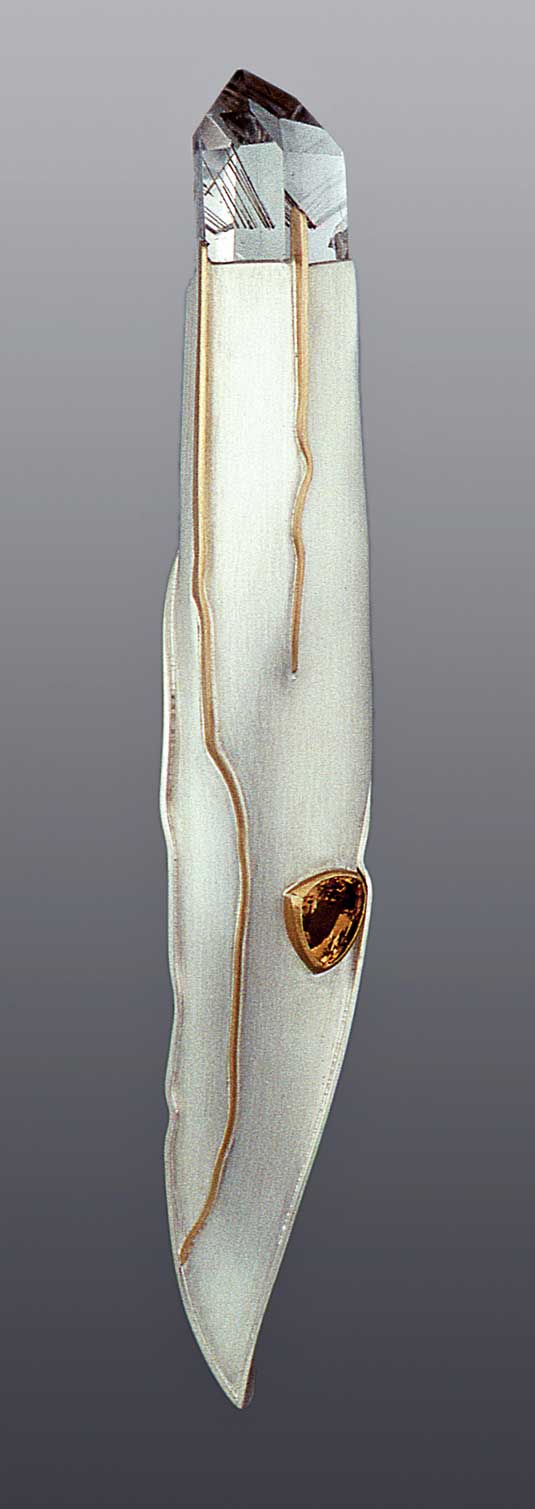
The large, strikingly beautiful brooches the artist is renowned for embrace, even celebrate, the imperfect. Moty’s mediums of choice are chunks of semiprecious gems such as quartz or agate, shot through with needlelike strands of minerals. Rutile, for example, will show up as inclusions of golds and reds, while tourmaline is represented by strands that are predominantly black or green.
Working in the studio at her Tucson home, Moty creates settings using silver and gold. She frequently incorporates other materials, such as black paper Micarta, a paper-and-resin product most often used for knife handles that makes a dramatic companion to luminous quartz.
Occasionally she’ll add an accent of a precious gem such as a diamond or sapphire. The results are works of art that happen to be wearable, miniature sculptures that are as at home in an art collection as they are on a lapel.
Moty found her calling as a jewelry artist early in her college career at the University of Illinois. “I started out in art education,” she recalls, “but I quickly knew I wanted to work in three dimensions. I switched over to jewelry almost immediately.”
Initially, she worked with metal, learning the ins and outs of metalsmithing, but quickly began pushing the boundaries of the medium by using electroforming and photo etching—techniques borrowed from manufacturing and chemistry.
Both photo etching and electroforming are complex processes, and Moty’s use of them to make art was revolutionary at the time. Photo etching is the process of using light-sensitive photoresist and ultraviolet light to fix an image onto a metal sheet and then using chemicals to etch the image into the metal.
Electroforming is a manufacturing process that uses electrical current and an electrolyte solution to create metal parts with high precision. Until Moty began using the technique for her jewelry making, it was confined to the manufacturing of electronics and medical instruments.
She continued exploring the techniques as a graduate student at Tyler School of Art and Architecture at Philadelphia’s Temple University, and before she had even finished earning her Master of Fine Arts, was hired to teach jewelry making at Moore College of Art & Design. Two years later, in 1972, she moved on to a position at the University of Wisconsin, Madison, where she taught until 2001.
Over time, the chemicals she used for photo etching began to take their toll. “The chemicals are toxic, and I’d be set up in unventilated spaces when I used them,” she says. “I had to stop working with them.” She switched her focus to stones, and once again quickly moved beyond the conventional. The ones that most appealed to her were those supposedly flawed, the rutilated or tourmalinated quartzes or agates.
The settings Moty creates are guided by what she sees in each piece. “It all comes from the stone,” she explains. “Something in the piece will catch my eye and be so strong, I must continue it into the metal.”
Phoenix gallerist John Reyes says Moty’s process sets her apart from other jewelry artists. “Most jewelers have an idea in their head, and they find a gem that fits into that element,” he says. “Eleanor finds the stone, then designs around it, so it’s a different process.”
Bruce Pepich, executive director emeritus at the Racine Art Museum, where Moty’s work is in the permanent collection, echoes Reyes’s thought. “Each stone is an individual, and Eleanor creates a setting that’s very specific to it,” he says.
He points to her Hanami Brooch as an example. Moty started with a quartz crystal that has tourmaline inclusions and several little bubbles. She played off the bubbles by setting tiny diamonds into the black paper Micarta she paired with the quartz, then, in a nod to the tourmaline strands, added incised lines of silver. “It’s a record of her dialog with the stone,” Pepich says. “She has made a very thoughtful, long-term exploration in this way of working,” he adds, “and her body of work is consistent, beautiful, elegant and meaningful.”




Eleanor Moty, Tucson, studiojewelerswi.com; jmcveighjewelry.com