


A Rare Look Inside the Studio of Iconic Late Artist Ed Mell
How working side-by-side with Ed Mell impacted the lives— and creativity—of his staff.
By John Roark | Photography by David B. Moore
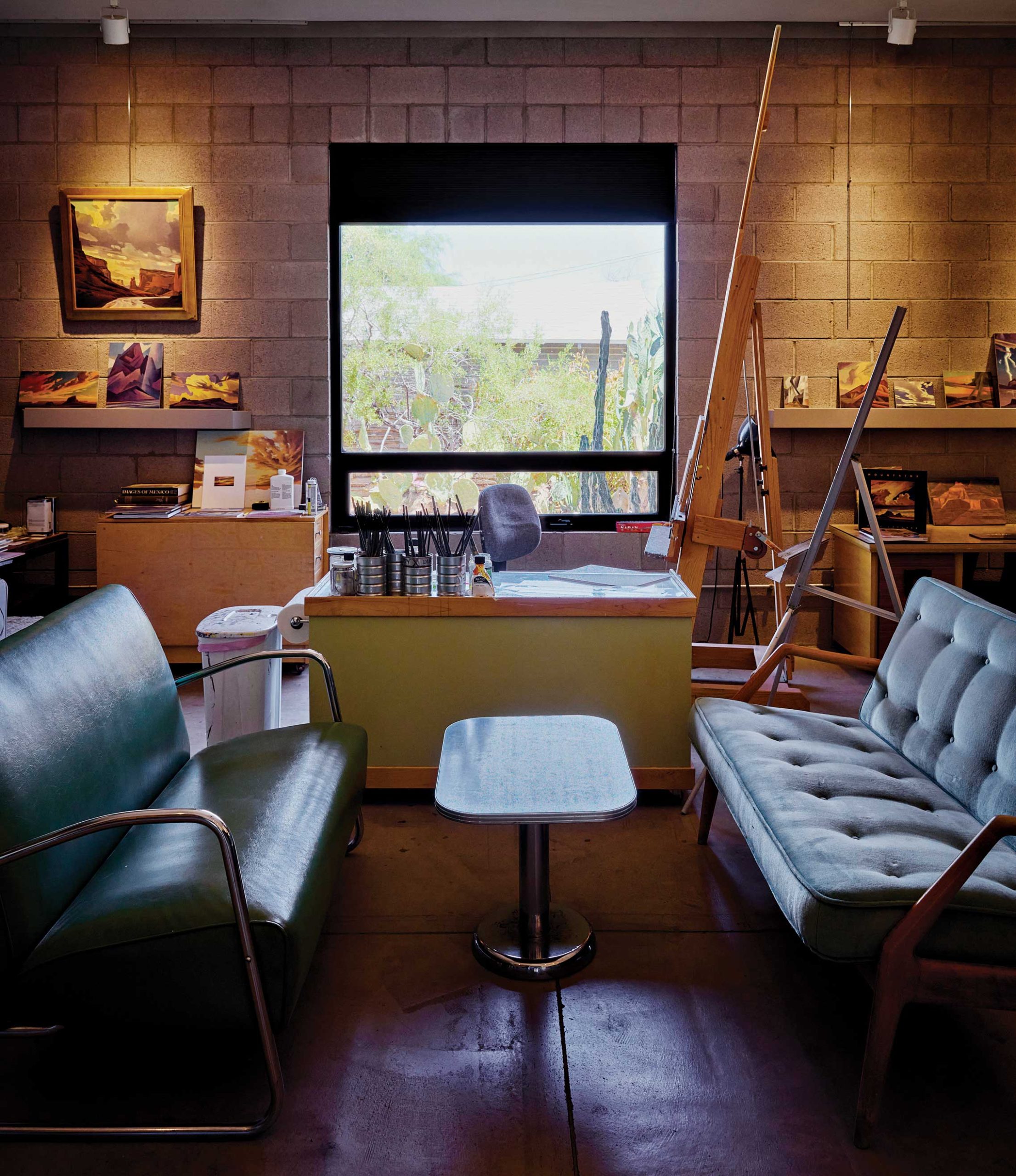
When celebrated artist Ed Mell passed away on Feb. 21, 2024, at the age of 81, he left a vast legacy of work that uniquely captured the landscape and spirit of the American West. For those who knew him—for decades or even briefly—Arizona’s favorite son is remembered not only for his work but also for his kindness, humor and generosity.
The loss is even more acute for two artists who worked and collaborated with Mell daily at his studio. “The first thing that comes to mind is being overwhelmed,” says studio and gallery director Ken Richardson. “It’s incredible how many people have contacted me. Everyone has a great story to go along with the pieces by Ed that they own. I wasn’t quite prepared for the response.”
Richardson met Mell in 1995 while stretching canvases, cutting mats and shooting slides of artists’ works at Arizona Art Supply. “Ed approached me one day and said he was looking for an assistant. I didn’t know who he was,” Richardson recalls. “Six months later, he came back, still needing an assistant. I couldn’t even remember his name, but he seemed cool. He invited me to come by the studio to check it out.”
The historic Coronado neighborhood where Mell’s studio is still located has come a long way since Richardson’s first visit. “It was kind of sketchy,” he remembers. “There was junk everywhere and lean-tos out back that looked like they were going to fall over. Ed brought me inside, and I thought, ‘Holy smokes, this is the real deal.’ This was like a dream. I am an artist, but I also enjoy seeing the processes of other artists. I was blown away by how tight the work was and that everything was done in-house. I thought I could learn a lot here.”

Richardson became an indispensable component of Mell’s business, stretching canvases, photographing finished artworks for archival purposes, managing sales and shipping, interfacing with clients and galleries, developing a website and, in 2015, overseeing the opening of the 500-square-foot Ed Mell Gallery, which operated for almost a decade down the street from the studio.
“Ed’s world had many moving parts that needed to be looked at, scheduled and followed through,” Richardson says. “I learned as I went along. From the beginning, he was very patient. It was almost like a graduate course that I didn’t have to pay for.”
Two-and-a-half years ago while working for Green Living magazine, graphic designer Victoria Klotz came by the studio with copies of a recently published article on Mell. She and Richardson began talking about art, and he asked if she would be interested in helping hang an upcoming gallery show. She jumped right in. “I got to try something new that I hadn’t had much experience with,” Klotz says. Subsequent invitations followed. “I was an open book for anything I could learn and observe. Eventually, I was shadowing Ken on everything he did.” She has been the studio and gallery manager full-time since 2023. “Victoria had the confidence and the skills to accomplish whatever we asked of her,” Richardson says.

For Richardson and Klotz, the opportunity to observe the artist in action, as well as his thought processes and techniques, had a profound effect on their own creativity. “At first, I didn’t understand Ed’s work because I came from a different genre of art,” Richardson says. “Probably a month in, I fully understood who Ed was, what he was up to and how he was bringing art deco and cubism into a contemporary conversation—and I saw that no one else was doing that. Ed mixed paints in a way only he could get away with. He was a master at complementary colors. He was also a master at giving you that saturated, heavy color up front on the canvas, like you’re right there. And as the image recedes, he knew how to back off.”

Klotz agrees. “I think Ed’s ability to understand how colors looked next to each other is what made him such an exceptional painter,” she says. “He did that effortlessly. As I became more immersed, I saw how this man was making art history. My viewpoint shifted. I see art completely differently now.”
Klotz also stresses the importance of the bond between Richardson and Mell. “There was a balance to how these men worked together as friends who ran a successful business,” she says. “They nurtured each other.”
The question many are now asking is, what happens next? Mell’s son, Carson, a respected screenwriter and producer living and working in California, inherited the Ed Mell Gallery, its copyrights and licensing and is working carefully with Richardson (whom he has known since he was a teenager) to ensure that his father’s legacy is preserved, protected and celebrated. The studio is open by appointment only, as Richardson and Klotz run the day-to-day and continue to digitize and archive the prodigious amount of works spanning the artist’s 50-plus-year career.
“I hope that there’s a way that more people can be exposed to the work,” Klotz says. “As much as we value his many private collectors, it’s important that people all over the U.S. find out who Ed was and why his work is so important. We can tell you. We can show you.”
Authentication is of primary importance, Richardson says, and steps are being put in place to ensure the legitimacy of every item authorized by the estate. “We want our collectors to know we will keep that market value strong. We’ll be releasing paintings as we go along. We would like to get them into the right hands, to showcase them, whether in a gallery or a museum.
“No one is going to own Ed Mell,” he continues. “He had a lot of offers to go to New York and drive up the prices of his paintings, and he said, ‘No. That’s not me.’”
“History was being made right here. What an incredible opportunity to have had.”
—Ken Richardson, studio and gallery director


SOURCES
- Ed Mell Gallery, Phoenix, edmellgallery.com
- Foundry: Bollinger Atelier, Tempe, bollingeratelier.com
- Framing: Collier Gallery, Phoenix, colliergalllery.com
- Archival pigment prints: CloudWatchers, Phoenix, cloudwatchers.com
- Studio remodel architects: Jon Kitchell and Lorenzo Perez, Venue Projects, Phoenix, venueprojects.com